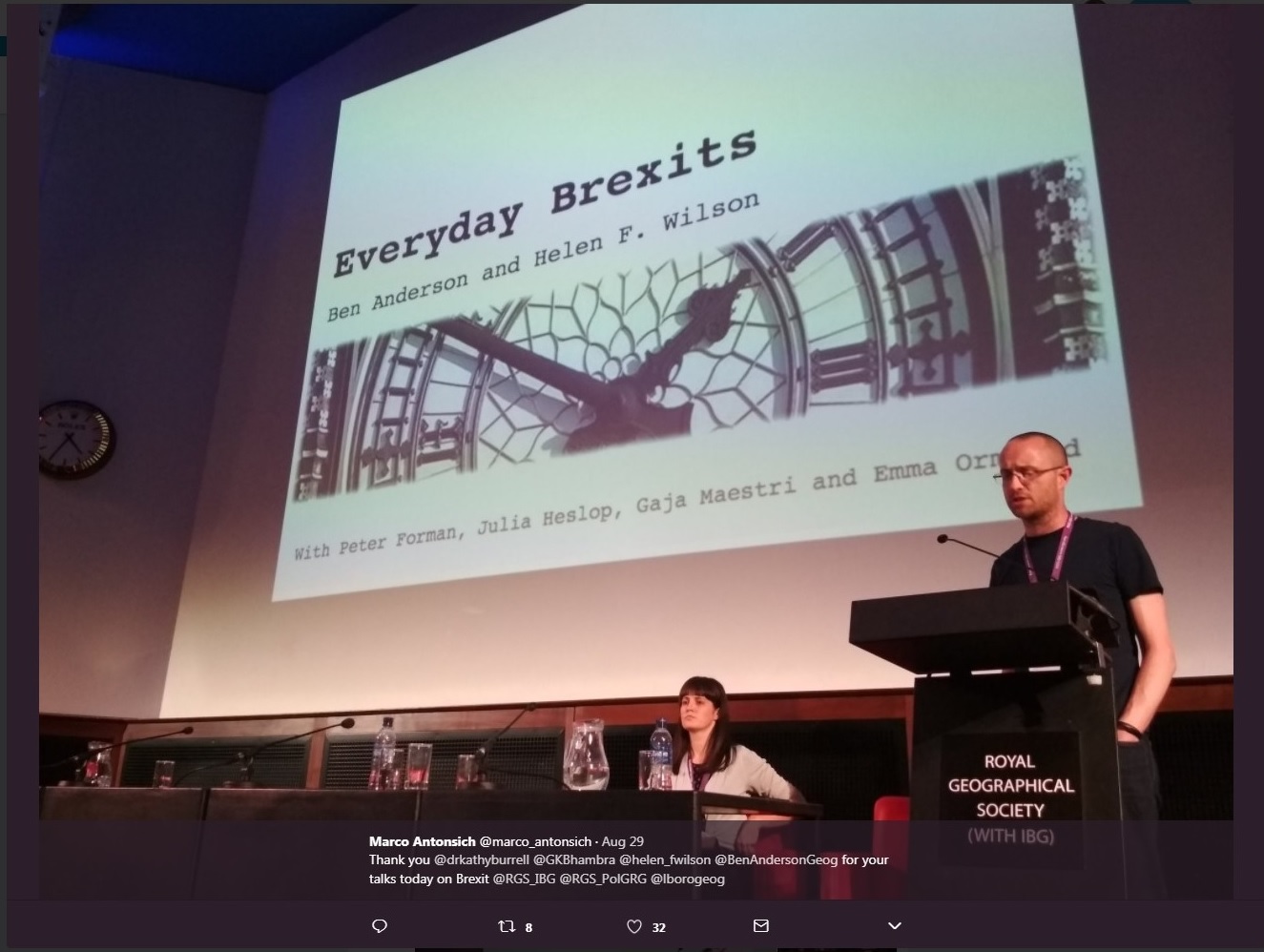
 During the last RGS-IBG annual meeting, our research group, in collaboration with the Economic Geography RG, convened a pre-conference workshop titled ‘Brexit: A Geographical Conversation’. The event, organised by Marco Antonsich (Loughborough University), Emil Evenhuiss (Cambridge University), and James Faulconbridge (Lancaster University), gathered seven prominent speakers who addressed the topic from a variety of perspectives. The event was opened by the keynote of David Goodhart, influential commentator and author of the recent book The Road to Somewhere (Hurst, 2017), who well captured the present polarization of British society in terms of opposing socio-political values. As clear from the lively debate which ensued from this presentation, the same polarized views were also present in the audience, which challenged the data Goodhart based his presentation on. The other two papers which formed the first session of the workshop on the causes and consequences of Brexit mapped respectively the uneven geographical distribution of the vote at the level of local authorities (David Manley, Ron Johnston, and Kelvyn Jones – University of Bristol) and the potential impact of Brexit on the regional development in the UK (John Bachtler – University of Strathclyde).
The second session of the workshop on the Brexit’s futures featured papers which analysed the more social dimension of the phenomenon. Kathy Burrell (University of Liverpool) presented the experiences of Polish migrants in the UK and their perspectives on remaining or leaving the country. Gurminder K Bhambra (University of Warwick and Linnaeus University) offered a compelling reflection on the links between a British imperial nostalgia and Brexit, whereas Ben Anderson and Helen Wilson (Durham University) introduced the affective atmospheres generated by Brexit in people’s everyday lives.
The event, attended by more than one hundred people, offered geographers the opportunity to show how their research engages directly with some of the key questions still on the table of the Brexit negotiations. The great interest around the workshop and the engaging discussions which surrounded the papers signal that more work can be done to examine the political, economic, and social geographies of Brexit.